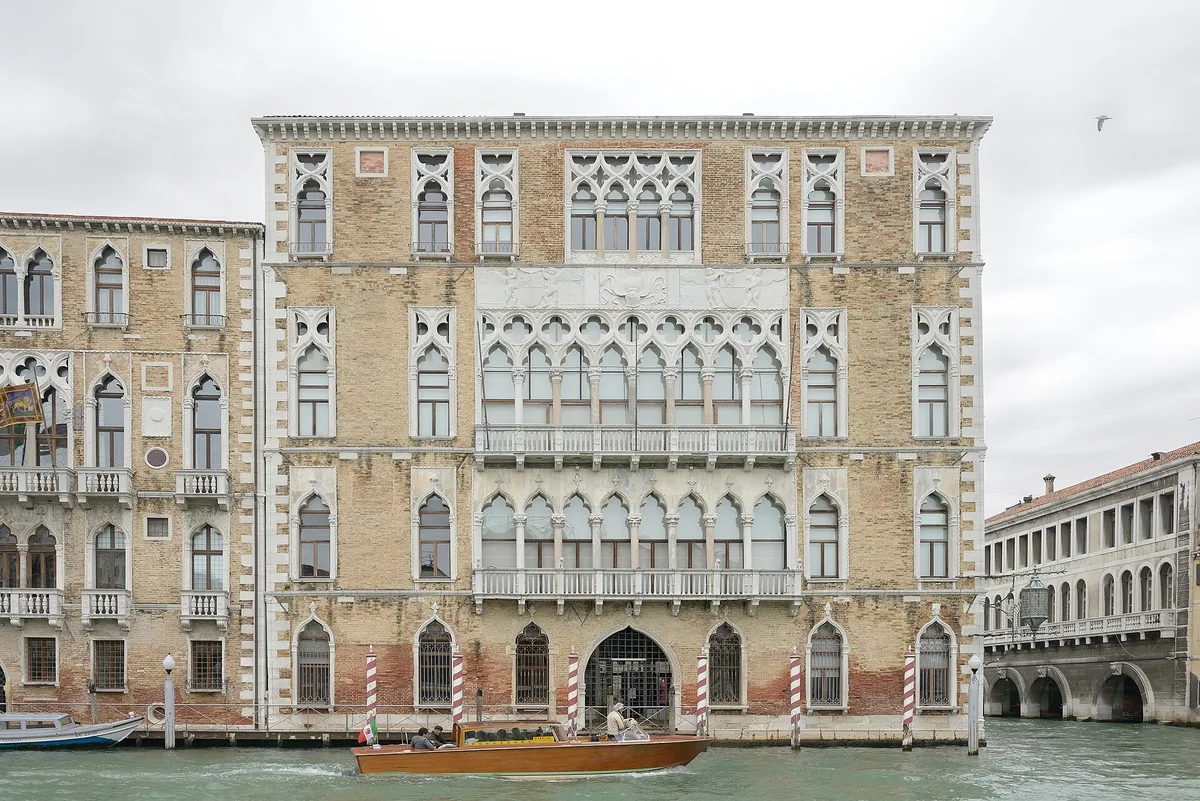
At the widest bend of the Grand Canal, Ca’ Foscari faces the water with a Gothic loggia that has become one of Venice’s most recognisable views. Its story links a doge’s private residence to diplomatic visits, a school of commerce and the architecture of Carlo Scarpa.
Researched 20 October 2026
From the House of the Two Towers
The site had a history before Ca’ Foscari. In 1429 the Venetian Republic bought the House of the Two Towers from Bernardo Giustinian and made it a representative building. Francesco Foscari acquired it at auction in 1453 and ordered a new residence. The university’s historical timeline identifies that year as the beginning of Ca’ Foscari. The earlier building’s name came from two towers and its position at the great bend of the canal.
A residence turned political stage
Ca’ Foscari passed to the doge’s family after his death. In 1574 it hosted Henry III of Valois, king of France and Poland, during a visit that brought Italian princes to Venice to pay homage. The palace’s place at the bend made its canal façade a conspicuous backdrop to public life. Canaletto later painted the Grand Canal Regatta in 1740, probably from one of the palace’s floors, according to the university’s account.
A late Gothic façade above the water
The university’s own venue guide describes Ca’ Foscari as a late Venetian Gothic palace built in 1453 under the direction of Doge Francesco Foscari. Its central Gothic multi-light window faces the canal; at water level, the entrance hall retains a portal onto the Grand Canal. The façade is best understood from the opposite bank or a boat, where the full sequence of openings becomes visible.
From military barracks to university
During the Austrian occupation in 1849, Ca’ Foscari was used as a barracks, one of several Venetian palaces put to military use; the university history records damage to its structure and decoration. After Venice joined the Kingdom of Italy, the Municipality gave the palace to the Royal School of Commerce, founded in 1868. That school was the first Italian institution for advanced commercial and economic education and the beginning of today’s Ca’ Foscari University.
Carlo Scarpa and a way to visit
In the 1930s rector Agostino Lanzillo asked Carlo Scarpa to restore spaces in the palace and design the university’s first great hall, now the Aula Baratto. Scarpa’s project of 1935–37 shaped its window, student tribune, wooden platform and marble details; in 1955–56 he added a wood-and-glass screen. Ca’ Foscari Tour currently lists free guided visits of about 40 minutes on selected Saturdays. Which rooms are open depends on university availability; check the official calendar before setting out.
The Saturday schedule and access arrangements can change. The official tour page is the current source for dates, departures, languages, booking requirements and which university spaces can be visited.
Open map → Ca’ Foscari Tour: visits and practical information → Return to the palace series →