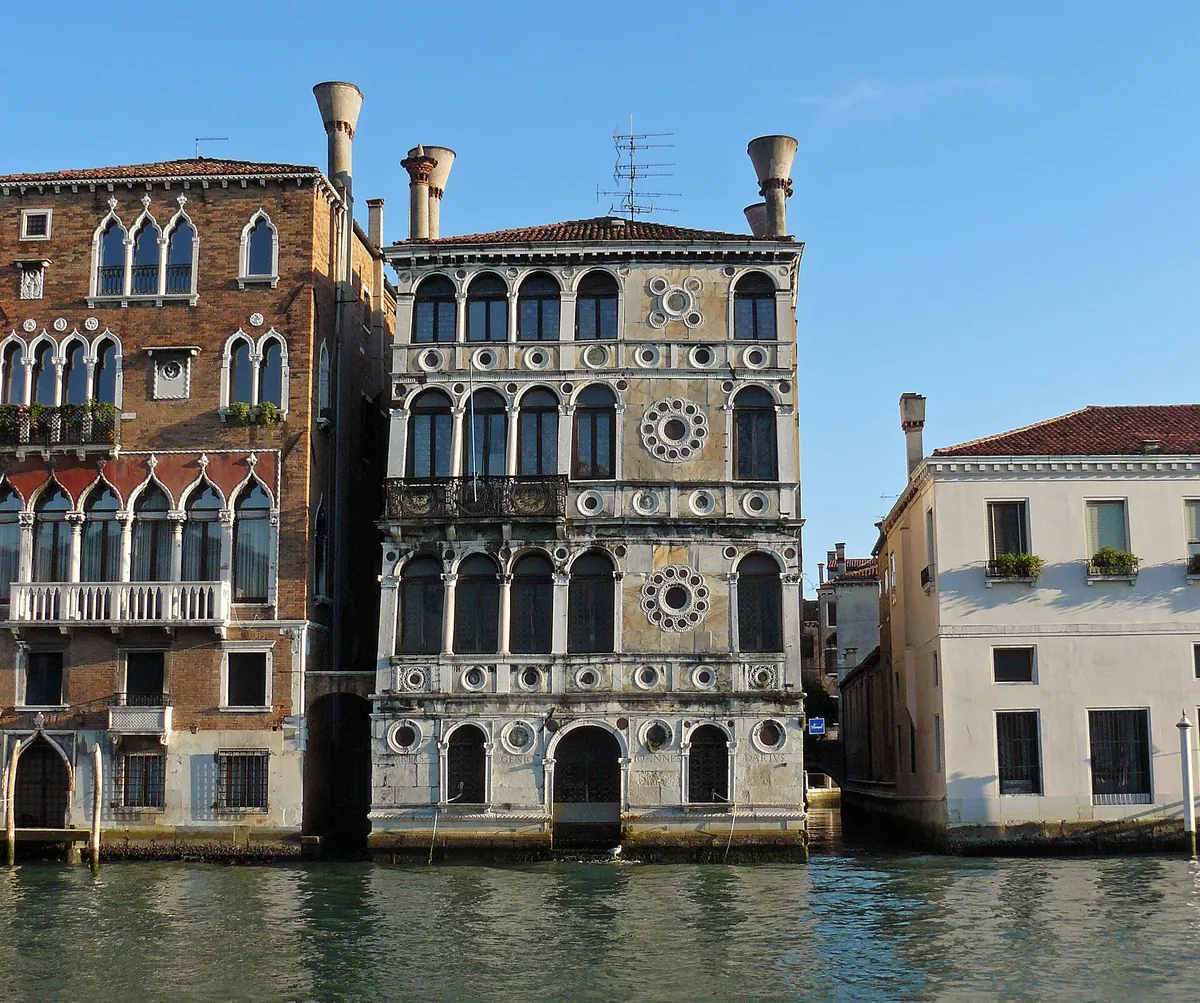
At the mouth of the Grand Canal, beside the Rio di San Vio, Ca’ Dario is easy to recognise for its coloured marble façade. Its history is often mixed with later legends. Two reliable sources let us tell a more grounded story: the wills preserved by the State Archives of Venice and Treccani’s account of Venetian Renaissance architecture.
Researched 20 October 2026
A house on the Rio di San Vio
The palace is named after Giovanni Dario, a Greek-born official from Candia (today’s Heraklion) who built his career in the service of the Venetian Republic. The State Archives identify the house at San Vio as his residence. The record places the story at a point where diplomacy, family life and architecture meet, rather than treating the building as an isolated image on the water.
A façade that speaks to the city
Treccani discusses Ca’ Dario among the late-fifteenth-century Venetian residences shaped by Lombard architectural culture. Its polychrome marble, classical references and the inscription “Urbi genio” — dedicated to the genius of the city — make the façade an unusually explicit statement about civic identity. The source does not settle every question of attribution, so this guide does not assign the design to a named architect as a certainty.
Giovanni Dario, diplomat of the Republic
Before arriving in Venice, Dario had worked as a notary in Candia and in the Venetian chancelleries on Crete, first in Sitia and then in the island’s capital. He later entered the ducal chancery and served as secretary to the Senate. The State Archives describe several important diplomatic missions in the East. The man behind the palace was therefore not a hereditary patrician, but a professional whose work connected Venice with the eastern Mediterranean.
Three wills and a family history
The archive preserves three wills dated 30 April 1489, 1 March 1492 and 1 October 1493. Dario died on 12 May 1494. Across the documents, his companion Chiara is repeatedly recognised as the “lady of the house”; provisions for his daughter change over time, and the papers also record an order to free enslaved people in the household after ten years of domestic service. These details are difficult, specific evidence of the people and power relations inside a fifteenth-century Venetian home.
How to see Ca’ Dario today
Ca’ Dario is a residence, not a museum with a published visitor route that we can recommend. Do not assume that its interior is open to the public. The façade is part of the Grand Canal panorama; choose a lawful public viewpoint or a boat service that actually follows this stretch, and check current routes and conditions before travelling. The map link helps locate the palace; our Grand Canal guide puts it in context with other nearby façades.
No public interior access is stated here without a current official source.
Open location in Google Maps → Explore the 35 palace stories →