Venice Journal · 2026-10-25
Doge’s Palace itinerary: power, the Bridge of Sighs and the waterfront
The Doge’s Palace is not simply a beautiful stop beside St Mark’s Square. It is where the Venetian Republic governed, judged and presented its authority, and the visit moves from ceremonial halls into the narrower world of the prisons. This itinerary sets the palace within a manageable day in San Marco, using our own guides as desk research, not a report from a recent visit.
Start with the ticket, not the queue
Before choosing a day, read the official website for the palace, managed by MUVE, to establish current opening and ticket details. Our guide says the standard visitor route normally connects the palace with the New Prisons through the Bridge of Sighs, subject to current access arrangements. It also notes that special itineraries, including restricted or behind-the-scenes routes when offered, can have separate reservations and access conditions. Do not assume a general admission ticket includes every advertised tour, and compare a multi-museum ticket only with the time and interest you actually have.
That distinction matters when you plan the rest of the day. If you want a guided interpretation of the institutional rooms, treat it as a separate decision from basic entry and check what the selected option includes. Ticket structures change, so confirm validity, included museums, entry conditions and any timed arrangements with the operator rather than relying on a planning article. Once the ticket is settled, the route through the palace becomes a sequence to follow at an unhurried pace, not a list to rush through.
Reading the rooms as a seat of government
The doge was Venice’s leading figure, but the palace tells a story larger than one ruler. Councils, magistrates and courts formed a complex political system, and the size and decoration of the institutional rooms help explain how the Republic wanted its authority to be seen. In the great halls, pause long enough to notice how painting and architecture work together. These are images made for rooms of power, not isolated pictures on a neutral gallery wall.
An audio guide or a well-chosen guided visit can make the institutional names much easier to follow. Without that support, the rooms can blur into a series of grand spaces; with it, the sequence begins to read as a working government. Our guide suggests setting aside around two to three hours as a planning allowance, longer if you enjoy detailed interpretation. That estimate is for the palace itself, so build in time before and after rather than treating it as the whole day.
The Bridge of Sighs and the prisons
The standard route normally leads from the palace to the New Prisons across the Bridge of Sighs, subject to current access arrangements. The contrast with the ceremonial rooms is one of the strongest parts of the visit. The bridge’s romantic name belongs to a later interpretation of prisoners glimpsing the outside world; seeing it from within gives context that the popular exterior photograph cannot.
Follow the marked circulation route. The passages are narrow and are not a place to stop for a long photo session. Our guide also advises checking the current accessibility route if stairs or confined passages could be difficult, and travelling without unnecessary large bags. This is desk research rather than on-site verification, so ask the operator about the route you would actually follow. Keep the crossing brief and let the change of atmosphere do the work.
Afterwards, see the palace from the water
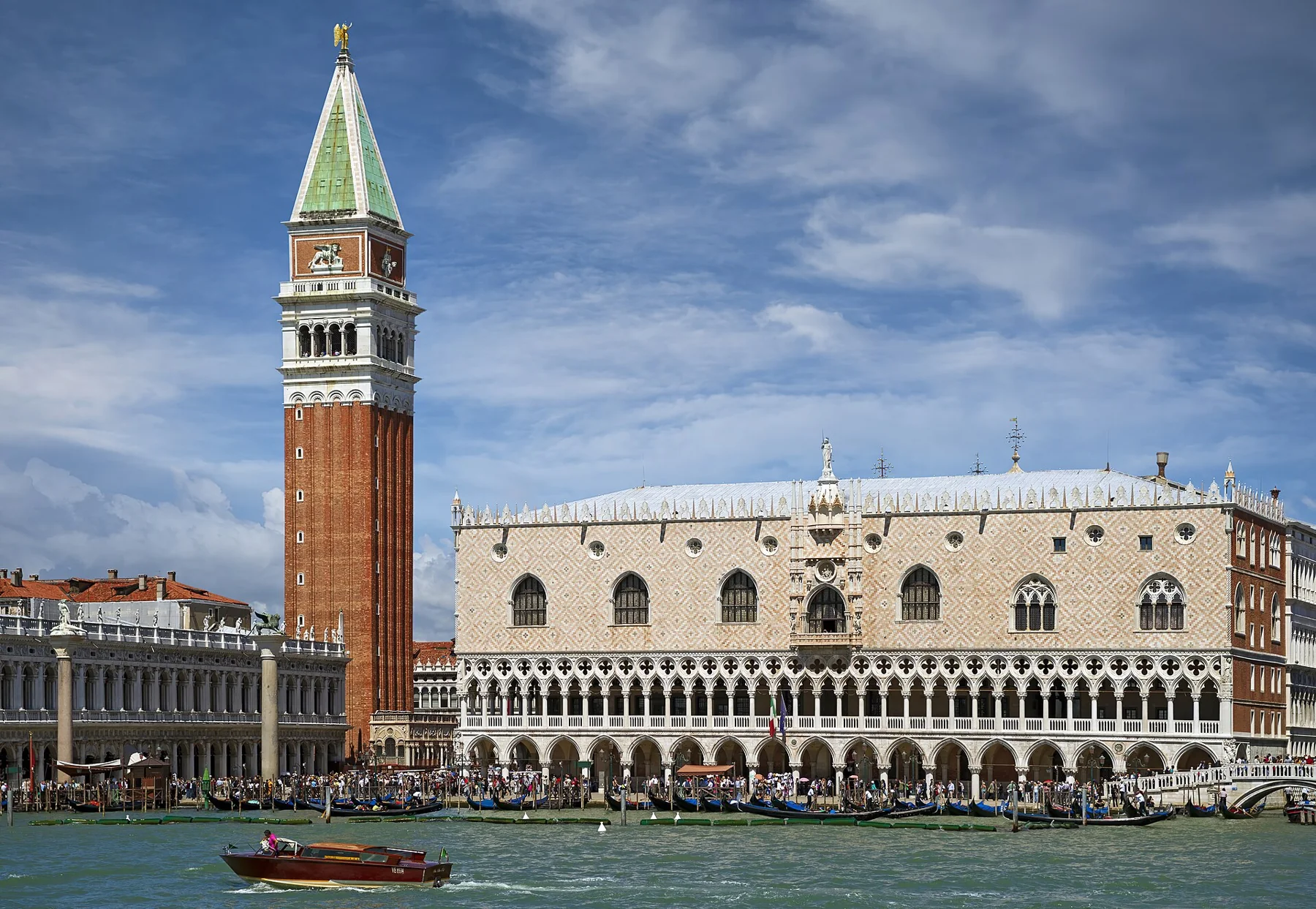
Once outside, the palace changes character. On the waterfront you can see it as part of the city’s public face, with St Mark’s Basilica beside it and San Giorgio Maggiore across the basin. This is a good moment to stop moving and look back at the building you have just walked through. The exterior view also makes clear how the palace sits between the square and the water, rather than standing alone as a single monument.
From here, a walk into Castello makes a good change of pace and leads away from the densest part of San Marco. Expect narrow lanes, stepped bridges and routes that turn inland when a canal blocks the way; there is no continuous walkway along the Grand Canal. Signs towards Rialto, San Marco, Ferrovia and Piazzale Roma help with broad direction, but a precise address still needs a map. Allow more time than a distance estimate suggests.
Building the day around transport and alternatives
Walking reveals the city’s detail, while waterbuses connect places that are awkward or impossible to join on foot. If the palace is your anchor in San Marco, keep the rest of the day on foot where possible and use the vaporetto only where it genuinely shortens the journey. At the landing stage, check the route number, direction and stopping pattern; large stops can have several platforms sharing one stop name. Buy and validate the appropriate ticket according to ACTV’s current instructions at the start of each journey and when changing services as required.
A pass is worth comparing with the journeys you actually expect to make, not with a vague idea of convenience. Several days spent mainly walking may not justify the same product as a stay on Giudecca or a full island day. Pass validity is generally measured from activation or validation under the product’s conditions, and exclusions such as airport travel and Alilaguna services should be read carefully. If you add an island, check both outbound and return timetables and leave room for weather and queues before any fixed booking. Alternatives to the palace day include a slower walk through Castello or a water-based itinerary; choose according to the time you have.
Keep exploring
Sources and photo credits
Independent travel editorial, drafted with AI assistance using our existing guides. Check changing practical information with official operators.
- Doge’s Palace — a thoughtful itinerary — Visit Venezia · 2026-10-26
- Photo: Didier Descouens · Source · CC BY-SA 4.0. Responsive image display.
